Fluxion
Case Study Details

Client
Healthcare Provider
Project
AI-Powered Clinical Decision Support Platform
Platforms
Web, Mobile
Users
2000+
Meet MedPilot AI
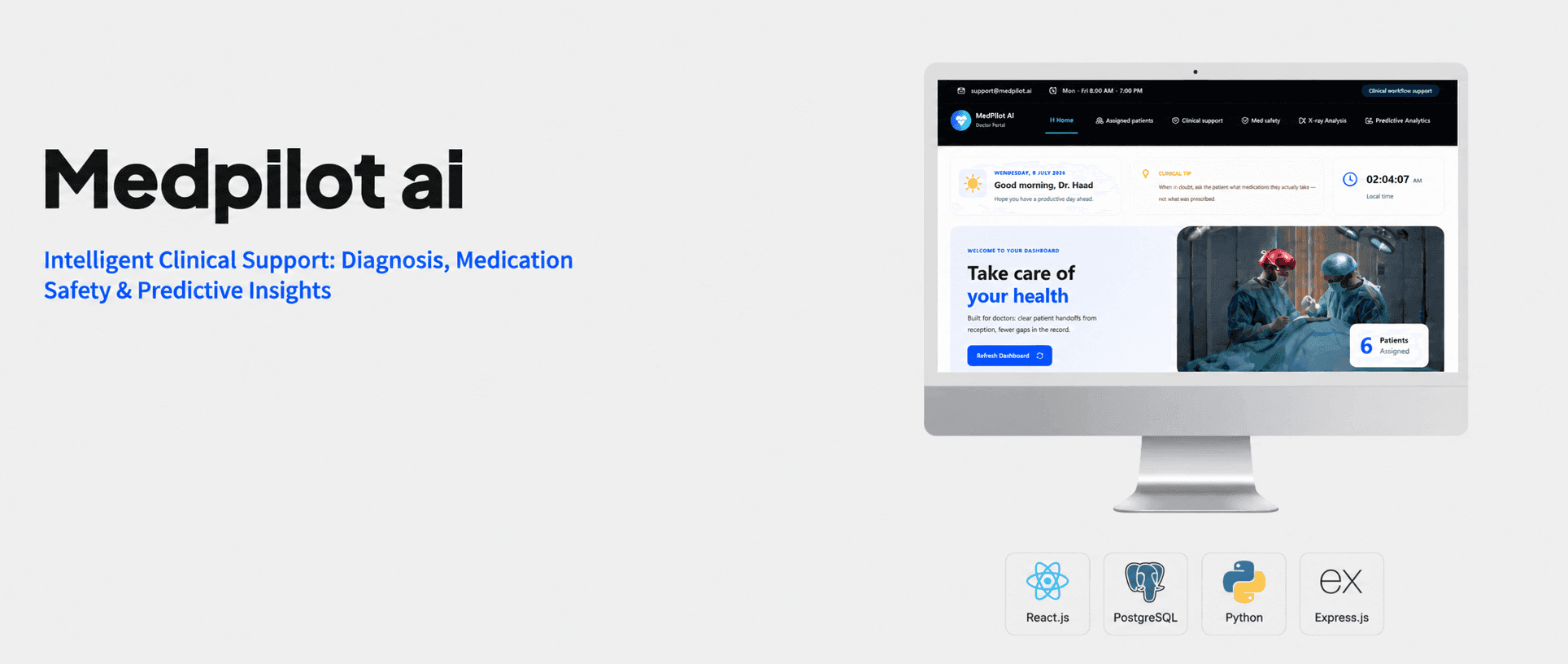
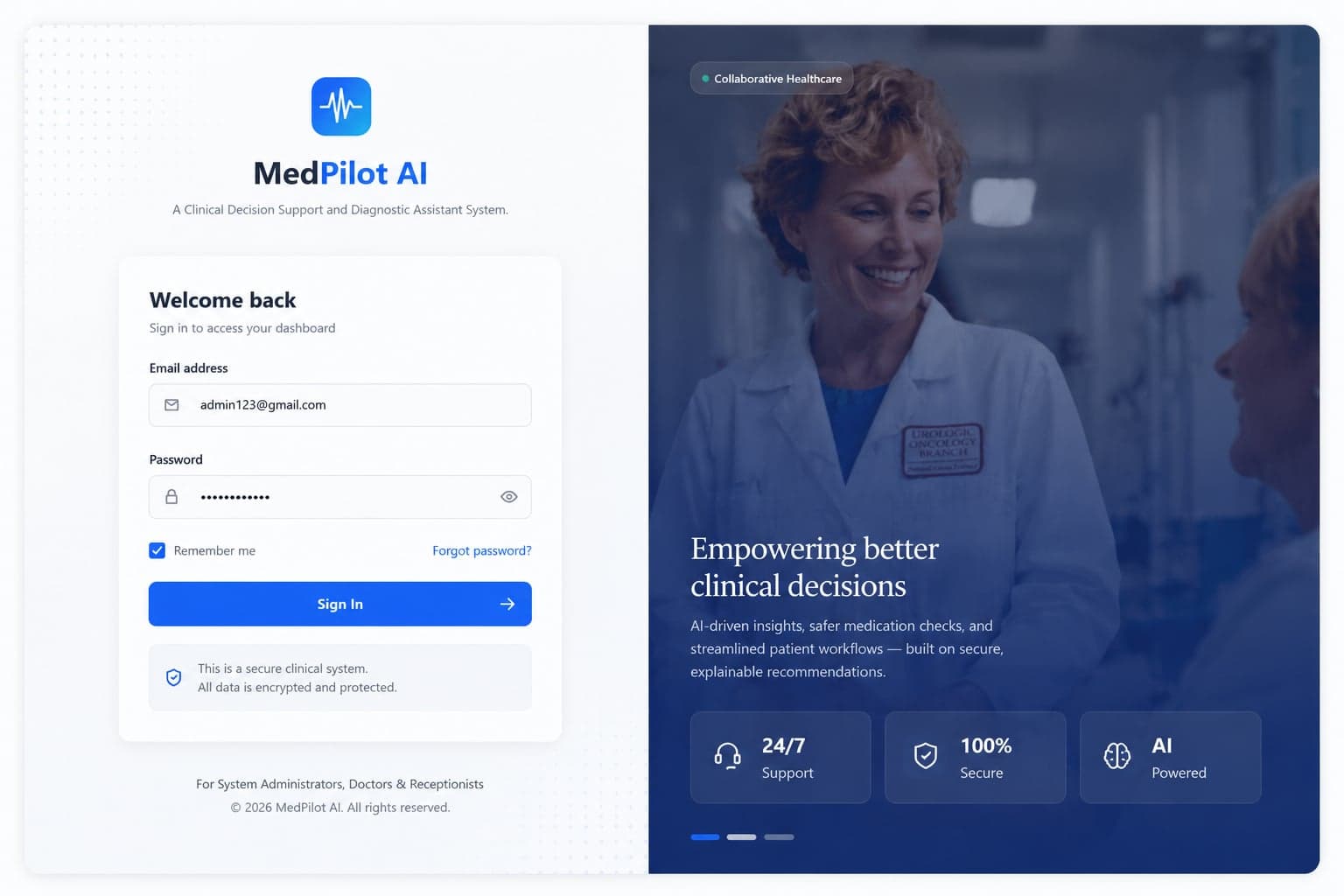
MedPilot AI is a clinical decision support platform that helps doctors reach faster, safer, evidence-based decisions while the patient is still in front of them.
The ChallengeA clinician works from patient data spread across disconnected tools: symptoms, lab results, imaging, history, and current medications, usually under real time pressure. Older decision-support systems run on fixed rules, show little of their reasoning, and fire so many alerts that staff learn to dismiss them. In Pakistan, thin digital health infrastructure compounds the problem, leaving doctors to rely on manual recall and raising the risk of a missed diagnosis or a dangerous drug interaction. MedPilot AI's team wanted one system that could explain itself and support a physician's judgment rather than override it.
Project Overview
MedPilot AI brings patient data, diagnostic reasoning, and medication safety checks together in one AI-assisted platform, so a clinician can reach an accurate decision faster and see exactly how the system arrived at it.
Goals & Success
The main goals were to reduce diagnostic uncertainty and cut medication-related risk. Success came down to diagnostic accuracy, how clearly each recommendation could be explained, and whether clinicians came to trust what the system told them.
The Solution: AI-Assisted Clinical Decision Support
Fluxion partnered with the MedPilot AI team to build a platform that puts clinical intelligence directly into the physician's workflow without hiding how it works or putting patient safety at risk.
How It WorksScanned lab reports pass through OCR and come out as structured data the platform can read. From there it produces a ranked differential diagnosis, each entry carrying a confidence score and the reasoning behind it. A medication safety engine checks every prescription against known drug interactions, recorded allergies, and contraindications. Predictive models flag patients at risk of chronic conditions early, and a deep learning model screens chest X-rays for abnormalities. Role-based access and AES-256 encryption protect patient data at every step.
Key Features
- AI Differential Diagnosis
- Reads patient symptoms, demographics, and history to produce ranked diagnosis suggestions, each with the reasoning that led to it.
- Medication Safety Engine
- Checks for drug-to-drug interactions, allergy conflicts, and contraindications, then recommends dosages based on the individual patient.
- Predictive Risk Analytics
- Applies machine learning to historical clinical data to flag high-risk patients and catch chronic conditions early.
- OCR Report Digitalization
- Turns scanned or photographed lab reports into structured electronic health data the platform can analyze.
Results & Business Impact
Clinicians get a ranked, confidence-scored differential diagnosis with the reasoning attached, rather than a single answer out of a black box. Automated checks on drug interactions, allergies, and contraindications catch medication risks that manual recall can miss. Because every recommendation is explained through SHAP-based attribution, a doctor can see what drove it and judge whether to act on it.
What was deliveredeight integrated modules covering OCR report digitalization, differential diagnosis, medication safety, predictive risk analytics, and chest X-ray analysis, on a four-tier architecture with AES-256 encryption and role-based access control. Built with React, Node.js, Python (XGBoost, CNN, LoRA/QLoRA fine-tuning), and PostgreSQL.
With Fluxion, MedPilot AI moved from a research concept to a working, explainable clinical decision support system built for real clinical adoption.

The Outcome
Business Impact
<5 sec
Diagnosis Speed
to generate AI differential diagnosis and risk assessment
<10 sec
Report Processing
to digitize and extract data from lab reports via OCR
<15 sec
X-Ray Analysis
for AI-assisted chest X-ray screening
50+
Concurrent Users
sessions supported without performance loss